I’m still having flashbacks from Marie NDiaye’s The Witch which was shortlisted for the 2026 International Booker Prize and translated into English by Jordan Stump. It was generally quite sad for me, but I could actually relate to the main character Lucie whose life seems to be forever stalled by an inability to commit to a direction, or muster the conviction to believe that the choices she makes are the right ones.
But don’t we all have moments like these though?? I just had one on Thursday when I worked from home.
It’s like you know what you need to do, but you’re not convinced that you can see it through to the end. I started to work on this primer thing that had to be outlined first then laid out on InDesign. I realised 20 minutes in, that it was a task that neither had a deadline nor a purpose other than I thought it was a clever thing to create.
It was past 10am, I hadn’t had coffee, and I needed to prep for a Teams meeting after lunch. I started to waver. I got up and thought, maybe some kettle-bell moves would perk me up. Bad call. When you begin flinging heavy things around on an empty stomach, well….then I spied the sliver of blue in the horizon suddenly fading out into a fast moving curtain of gray rain. Fuck, the laundry on the line. I ran out to get the clothes just as I could feel the rain on my head and thought- wait, arroz caldo! I have chicken wings in the deep freeze and arroz caldo would be perfect on a day like this!
Lucie was a witch but not a particularly powerful one because her mother was ashamed of it. So when it was passed on to her, the power was weak. Generational deficits? Lucie also thought too much. She had ‘morals’ and didn’t particularly think that using your witch powers to your advantage was honest. She doubted (and rejected) a gift that in the end, she could have shaped the way she wanted.
I mean come on right? Who in their right mind would say no to something that was given to you naturally?? It’s not like you’re breaking the law. The things you could do with it…
Hex someone annoying by giving them diarrhea on the dot at 10am every day for a month; make your pimples disappear; grow a gym body without working out; predicting the winner of a horse race and betting on it accordingly; making someone fall in love with you (!)
But her pre-teen daughters were more pragmatic about it when it was their turn to be taught on using and harnessing the gift. But maybe you know- it’s that generation. They take to the gifts, like a child to an iPad, except that this was magic. This was so much more than living your life by just tapping on your phone. And justifiably, inevitably, they literally transform into birds and fly off, abandoning their mother to her wishy-washy fate.
But I digress.
What I really wanted to say was that the book came at an elegantly thin 144 pages which I finished in three days. Now, that’s a story you can really commit to finishing because the unintended overarching lesson here is, we can’t take big bites out of life all the time. You are permitted to deal with manageable pieces that will ultimately be easier to commit to and finish.
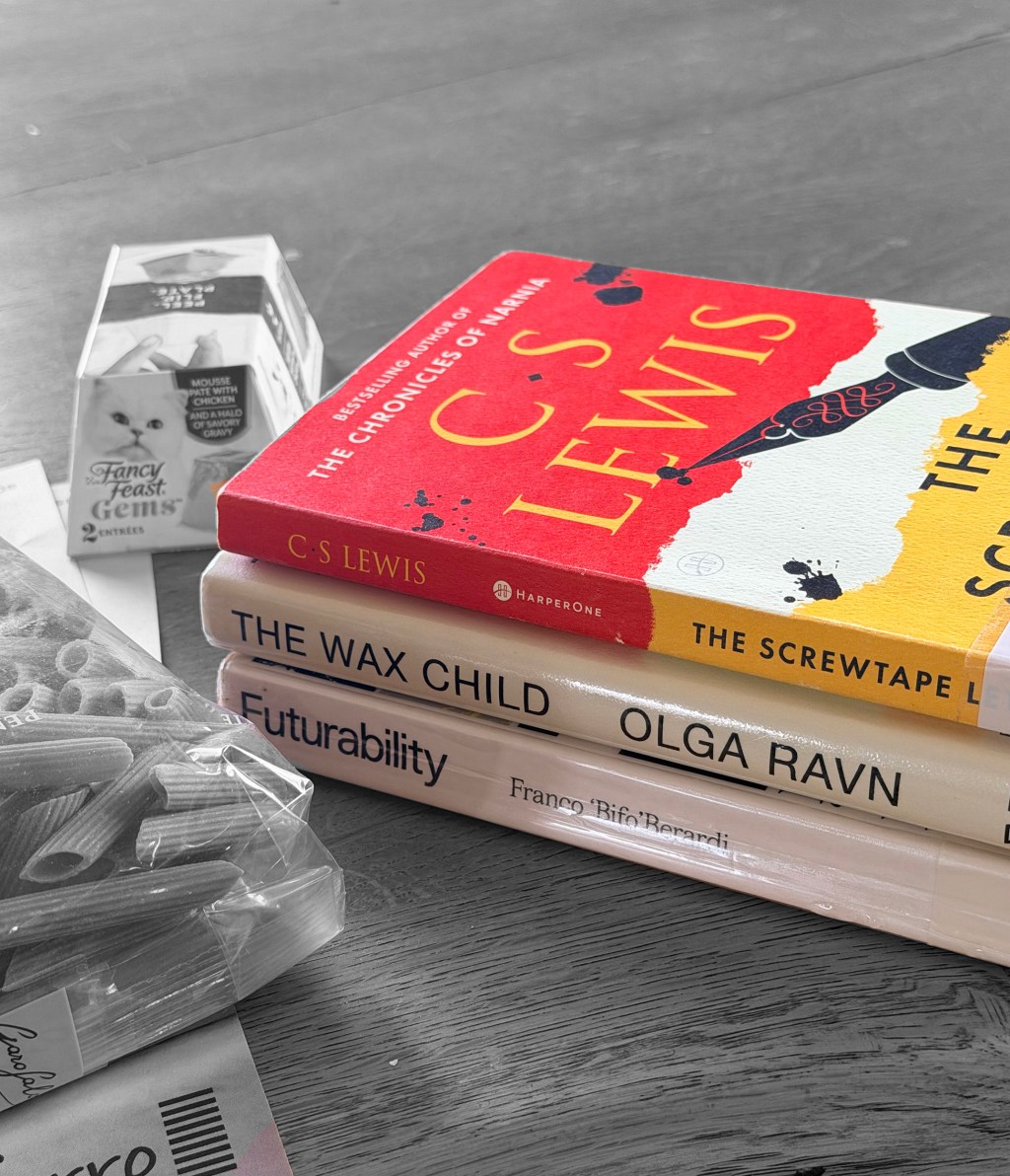
The Wax Child by Olga Ravn: ticks three on my list; 1) 176 pages, 2) young author, 3) strange. Also International Booker Prize long listed. It was a black night in the year 1620 when Christenze Krukow made the wax child, when she melted down beeswax and set it in the image of a small human. For days, she carried it tucked beneath her arm, shaping it with the warmth of her flesh, giving it life. She fashioned for it eyes and ears that cannot open, and yet – it watches and listens (Penguin books).
The Screwtape Letters by CS Lewis (160 pages paperback): I’ve never read Lewis outside of Narnia so I’m curious. First published in February 1942, the story takes the form of a series of letters from a senior devil, Screwtape, to his nephew, Wormwood, a junior tempter. The uncle’s mentorship pertains to the nephew’s responsibility in securing the damnation of a British man known only as “the Patient” (Wikipedia).
Futurability: The Age of Impotence and the Horizon of Possibility by Franco Berardi (224 pages paperback): I don’t normally go for non-fiction books, but the blurb on this one convinced me to pick it up; We live in an age of impotence. Stuck between global war and global finance, between identity and capital, we seem to be incapable of producing that radical change that is so desperately needed. Is there still a way to disentangle ourselves from a global order that shapes our politics as well as our imagination?


Leave a Reply